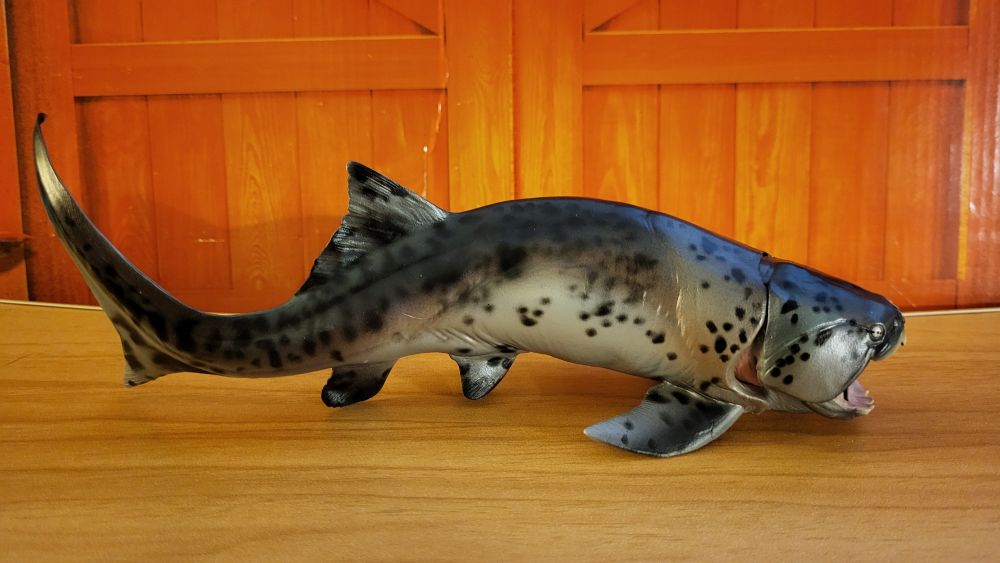
My absolute gratitude to Blissful Hen Toys for generously sending this little determine of a cute fish for me to overview right here. You possibly can choose up this determine, and plenty of others prefer it from there as effectively.

Whereas I am keen on quite a lot of prehistoric fish (like that foolish Sacabambaspis that turned a meme a number of years in the past), there’s however one which has captivated me extra then another since my childhood. That is none different then Dunkleosteus, an historical predator of the Devonian seas. Whereas Otodus megalodon might be essentially the most well-known prehistoric fish on this planet, and Dimetrodon could be essentially the most well-known Paleozoic animal, Dunkleosteus is well the second most well-known prehistoric fish, and Paleozoic animal. Or maybe extra particularly Dunkleosteus terrelli, the biggest species (and brought a step additional, specimen CMNH 5768 is probably essentially the most well-known. CMNH by the best way stands for Cleveland Museum of Pure Historical past). From casts of its varied skulls (and different stays) held in museums around the globe, quite a few books on prehistoric life, or media like documentaries (BBC’s 2003 Sea Monsters, and so on), video video games (Frontier’s 2021 Jurassic World Evolution 2, Studio Wildcard’s 2015 Ark: Survival Developed, and so on), and even motion pictures just like the latest Jurassic World Rebirth within the type of a cameo, this historical predator continues to fascinate those that get pleasure from prehistoric life. My first introduction to Dunkleosteus was nonetheless within the 1996 e-book “Life Starts in the Sea“, adopted by Pennsylvania Fishes, a information to fish throughout the state, which I used to be gifted a replica of when successful first place in PA’s farm present aquaria contest someday again within the mid 2000’s. Along with all these, there’s additionally the toy market as effectively. Almost each prehistoric toy firm in recent times has produced a Dunkleosteus, or not less than an excellent variety of them (see the critiques on the weblog right here for a portion of them.

Again in 2021 PNSO joined these after they launched a big number of marine taxa spanning from the Devonian to the Miocene, together with Dunkleosteus. They’ve given it the title Zaha. I received’t fake that I do know what the title means, or its origins, however a fast net search suggests it’s of Arabic origin, usually for a lady, and means “sensible”, “shiny”, and so on. I feel that might be becoming then with the iridescent coloration of the mannequin, assuming it’s appropriate in any case. It’s quantity 47 within the Prehistoric Animal Fashions sequence, and like different fashions on this sequence features a booklet with photographs of the determine, a skeletal reconstruction, and a bit of story based mostly on the animal. It additionally features a implausible poster of the Dunkleosteus breaching out of the water with a shark or the like. It could be in reference to potential abdomen contents of a specimen of Dunkleosteus terreli (CMNH 8735), within the type of tooth from a chondrichthyan (the group of cartilaginous fishes that sharks, and rays belong to), doubtlessly from the genus Orodus (Carr and Jackson, 2008, and Ferrón et al, 2017), or art work of Dunkleosteus depicted looking Cladoselache as seen in this paper (Carr, 2010). Earlier than addressing the mannequin itself although, let’s delve into the historical past on this historical animal.

Amazon advert:


The genus Dunkleosteus, like many fossil animals discovered previous to the advances in trendy paleontology, was a wastebasket taxon (and doubtlessly nonetheless is). Briefly, a lot fossil materials had been assigned to the genus early on (if not a lot later as effectively), which could not truly belong to this genus. This additionally carries over into the genus Dinichthys that Dunkleosteus terreli was initially assigned to. It was initially named by John Robust Newberry as “Dinichthys terreli” in a footnote within the 1873 “Geological Survey of Ohio. Volume I. Part II. Paleontology.” on web page 322. The genus Dinichthys itself was additionally solely named a number of years earlier in 1868, in Newberry’s paper “On some outstanding fossil fishes found by Rev. H. Herzer within the black shale (Devonian) at Delaware, Ohio”, printed within the Proceedings of the American Affiliation for the Development of Science. “Dinichthys terreli” was named after Jay Terrell who discovered effectively preserved materials belonging to it in Sheffield, Ohio, and took nice care with it. On the prior web page, it’s written in one other footnote that a few of this materials was destroyed in a fireplace that occurred the identical yr. The fabric was not less than photographed earlier than its destruction, as seen on plate 32 and 33 (materials in plate 34 was additionally attributed to this species, however solely these in 32 and 33 had been talked about to be destroyed). Although it wasn’t till a mandible was found by a “Prof. A. A. Wright” that make clear the variations between the Dinichthys materials obtained in Delaware, and from that obtained in Sheffield, Ohio, and what in the end led to Newberry creating the brand new species. The newly named species wasn’t described in additional element till the 1875 “Geological Survey of Ohio. Volume II. Part II. Paleontology.“, together with extra materials found by Jay Terrell since.


There have been quite a lot of publications following within the years since (resembling Branson, 1908, Heintz, 1932, and so on), nevertheless it wouldn’t be till 1956 when the genus title “Dunkleosteus” can be created and assigned, almost a century after “Dinichthys terreli” was first named prior. Within the article “Les arthrodires du Dévonien supérieur du Tafilalet (Sud Marocain)” printed within the French “Notes et Mémoires. Service Géologique du Maroc. 129”, it was named by Jean-Pierre Lehman to honor paleontologist David Hosbrook Dunkle, who on the time was curator of vertebrate paleontology within the Cleveland Museum of Pure Historical past. He additionally researched and printed on fossil fish fairly a bit. The title “Dunkleosteus” is thus a mix of his final title, and the Greek ὀστέον/ostéon which means “Dunkle’s bone”. Almost 60 years later after the genus Dunkleosteus was named, it was additionally decided that Dinichthys was not intently associated to Dunkleosteus both (Carr and Hlavin, 2010). So with “Dunkleosteus terreli“, the title honors not one, however two males which have made vital contributions to paleoichthyology.


As talked about earlier, the genus Dunkleosteus terreli was from the Late Devonian interval in what’s now the Cleveland Shale, in Ohio (and doubtlessly elsewhere). It particularly lived through the Famennian, the ultimate stage of the Devonian interval (if not earlier through the Frasnian stage in different areas). Traditionally it was thought-about to belong to the Arthrodira, and in flip Placodermi, and that’s how I’ll be treating Dunkleosteus for the needs of this overview. Placoderms had been jawed fishes, with the entrance halves coated in bony armor, and the latter half product of cartilage (principally), and arthrodires had been only one department of these (with many various sub branches, and so forth). The Cleveland Shale was residence to not solely Dunkleosteus terreli, however quite a lot of different placoderms, resembling Bungartius, Heintzichthys, and the big filter feeding Titanichthys, along with many chondrichthyans like Cladoselache, Ctenacanthus, Stethacanthus, and Orodus as talked about earlier. There have been additionally a number of bony fishes discovered (Carr and Jackson, 2008, and Carr, 2010). Along with potential predation on Orodus, there seems to be harm on each a specimen of Dunkleosteus terreli and Titanichthys (per Anderson and Westneat’s 2009 paper).


Regardless of its recognition, the majority of the fossil materials we have now for Dunkleosteus terreli is of its bony armor, consisting of the cranium, and a number of the thoracic elements of its physique. Nonetheless as well as, there’s additionally elements of its pectoral (shoulder) fin (Carr, Lelièvre, Jackson, 2010), part of the vertebral column (from a subadult; Johanson et al, 2019), and even some pelvic materials (Engelman, 2024, linked beneath). The remainder of its physique consisted of a cartilaginous skeleton, which might be inferred from kinfolk with gentle tissue preservation resembling Coccosteus cuspidatus, Incisoscutum ritchiei, or the not too long ago named Amazichthys trinajsticae (Jobbins et al, 2022), amongst others. Most reconstructions of Dunkleosteus specifically had been based mostly on the sooner reconstructions of Coccosteus cuspidatus (resembling seen in Miles and Westoll, 1968), which had been depicted with an eel-like (within the informal sense) tail fin, together with estimates for its basic physique measurement (at occasions). This goes for lots of the toys produced of it, and media appearances as effectively. Revealed in early 2023 was a paper by Russell Engelman that revolutionized our understanding (not less than in the meanwhile) of the Dunkleosteus terrelli physique measurement based mostly on quite a few components together with its fossil stays, stays of kinfolk, and the brand new metric he created referred to as the orbit-opercular size (utilizing an insanely giant dataset, with over 3000 specimens, and over 900 species). To cite from the paper, the orbit-opercular size is described as being “the size from the anterior margin of the orbit to the posterior margin of the top”. There’s a extra detailed breakdown in a while within the paper describing it, however I urge people to test it out for themselves. As being one of the vital standard prehistoric fish on the market, and with most prior estimates having it vary from over 4 to even 10 meters in size (Anderson and Westneat, 2009), it was initially met with skepticism at occasions from people within the paleo neighborhood (together with from myself), because the notorious “Dunk”, considered one of many earliest vertebrate apex predators, was now shrunk. Russel’s paper provides an estimate starting from 3.1 to three.5 for CMNH 5768, as much as 4.1 for the biggest specimen CMNH 5936 (which solely consists of a part of the decrease jaw armor, or extra particularly a left inferognathal).

Not stopping there, Engelman launched another paper in late 2023 following up on the sooner 2023 measurement paper, in addition to an early 2024 paper delving into creating an in-life reconstruction of this historical animal (inside anatomy, and ontogeny/life levels as effectively). There’s additionally yet one more 2023 paper from Engelman, and it’s principally regarding the technique used to estimate Dunkleosteus physique measurement within the 2017 paper by Ferrón et al. The final paper centered on giving us any reconstruction of types previous to Engelman’s work was the 2017 paper by Ferrón et al. (so far as I’m conscious) which gave help to Dunkleosteus terreli being a pelagic predator, possible having a fluked tail like seen in extant sharks. This contrasts with the sooner reconstructions of the eel-like tail based mostly on Coccosteus cuspidatus (Miles and Westoll, 1968), which can also be now outdated due to Engelman’s 2024 paper on the very least, which depicts it with a fluked tail based mostly on specimen ROM VP 52664 (if not others). The wanting it’s that the PNSO determine is simply too lengthy, though it was clearly sculpted earlier than these papers dropped. I don’t fault it for that, however I did sort of suspect way back in 2021 that the determine was too lengthy (if partially from the place of the dorsal fin, a bit extra of my prior ideas here as effectively). In truth the PNSO making of Zaha video even mentions the older 6 meter plus measurement estimate. The determine itself is roughly about 9 inches/22.86 cm lengthy (which is sort of PNSO’s marketed size of 23 cm). Utilizing my tough measurement of the determine, with the 6.88 meter whole physique size estimate of CMNH 5768 from Ferrón et al’s 2017 paper with the determine in an internet scale calculator places it round 1:30 scale roughly. With their measurement of CMNH 6090 at 5.34 meters, provides it an approximate scale of 1:24 (there’s a purpose this one was included, see the anatomy of the top part of the overview beneath). With their estimate of the biggest specimen CMNH 5936 at 8.79 meters, provides a scale of 1:38. Utilizing it with the ten meter estimate (Anderson and Westneat, 2009) would put it round 1:44 scale. Utilizing an identical technique of measuring the top as Engelman did for the preliminary 2023 paper (see this post), provides the mannequin a size of about 1.25 inches/3.175 cm give or take (on account of utilizing a stiff metallic ruler). Evaluating it to Engelman’s up to date head size of 61.3 cm for the grownup CMNH 5768 provides a tough scale of 1:19 (see supplementary file 1 of that 2023 paper). Evaluating it to the 51 cm head size of CMNH 6090, provides it a scale of about 1:16. The width of the jaw (when open), is about 1.375 inches/3.49 cm, together with the sides of the suborbital plates. The peak of the tail fin is about 3 inches/7.62 cm, whereas the peak of the dorsal armor is about 1.625 inches/4.13 cm give or take. The width of the determine together with its pectoral fins is about 3 inches/7.62 cm, whereas the width of the thoracic armor, or the higher torso is about 1.5 inches/3.81 cm. There’s much more to deal with right here relating to the anatomy, however I’m solely simply getting began.


Beginning with the top for the anatomy of the determine, so far as I can inform, all major plates are accounted for. As for the thoracic armor, it’s laborious for me to inform on the sculpt if every part is accounted for, with it supposed to be coated in pores and skin, however the main elements seem like current. The ventral defend ought to most likely be extra curved, and seem barely deeper, because it as an alternative seems to be flat, based mostly on older reconstructions. That is partially because of the nature of how the assorted Cleveland Shale specimens fossilized, however different specimens discovered elsewhere (resembling CMNH 9951) do protect the curvature of the ventral defend. So far as I can inform, the form of the suborbital plates seems to be like CMNH 6090 essentially the most, give or take, possibly even a bit like CMNH 7424 regarding the roundness of them (extra so on the correct aspect from what I can inform). That is evaluating it each to the 2D reconstructions from Engelman’s 2024 paper, and with 3D fashions of the fabric (resembling these on sketchfab). Value noting that CMNH 6090 is a subadult specimen, and never totally grown like CMNH 5768, and CMNH 7424 is a juvenile, youthful then CMNH 6090. Type of peculiar they didn’t simply go along with the form from CMNH 5768 on this regard, contemplating how widespread the mount of it’s in museums and the like, however eh. For this reason I included the sooner scale estimates with it. Granted the cranium may have been based mostly on one other specimen totally, and never any of those. The eyes seem like small in proportion to the top’s armor, just like the subadult CMNH 6090 and grownup CMNH 5768, however do seem like as giant the attention’s orbit (so far as I can inform). The 2024 paper mentions that the sclerotic ring discovered throughout the eyes would have almost stuffed the orbit, and the rings within the mounted CMNH 5768 use plaster replicas, though the rings had been discovered preserved on the top defend. The eyes on the determine moreover wouldn’t have the bony sclerotic ring seen. Whereas many people on the corresponding discussion board right here have been in favor of this for years now, the 2024 paper does open the doorways to them being seen, if not less than in a delicate method. Moreover the schlerotic rings weren’t flat, and did have a bulge to them. There’s not less than one pair of nostrils sculpted on the determine, and whereas the 2024 paper does point out there must be a secondary pair like on most different jawed fishes (which I’ve solely simply realized of when penning this overview), I’m undecided if that pair would have been too small to incorporate because of the measurement of the determine, or whether it is included, and I’m simply not choosing up on it.


Now for maybe essentially the most thrilling facet of the determine, which is the jaw articulation. PNSO has pulled off some unbelievable engineering to get this to work. Most different figures of Dunkleosteus solely have an articulated decrease jaw like in theropod dinosaur figures, and so on. So far as I do know this PNSO determine remains to be the one one to have accomplished this up to now. When the decrease jaw is opened, the higher jaw articulates with it, or vice versa. This seems to be based mostly on work from Anderson and Westneat (2006, and 2009) that exams a four-bar linkage system speculation (together with estimating chew pressure) that Dunkleosteus could have used to open its jaws. The 2009 paper mentions that 45 levels is the utmost the jaws can open, and I feel that applies to the determine as effectively, roughly. So far as the location of the gills goes, it seems to be like they could be appropriate per the 2024 paper, as they’re described to be situated between the top and thoracic armor in Dunkleosteus terreli, along with arthrodires usually having them situated below the bony plates of the cheek and jaws. Additionally they solely develop into seen when the mouth is open on the determine, one other facet the paper mentions. Although maybe they may lengthen a bit extra close to the decrease jaw (when the mouth is open). In PNSO’s video, it’s talked about that the mouth elements weren’t given in depth extraoral tissue (aka “lips”). Whereas speculative, I do like how the principle physique coloration fades in on the extra bone like coloration of the gnathal plates.


Transferring on to the physique itself, other than general physique size being too lengthy as addressed earlier, the physique shouldn’t be so curved, significantly close to the anterior, or entrance half, of the animal. Whereas it does give the determine some life to it, it could have been implausible based mostly on what we have now relating to its backbone. The portion of vertebrae preserved in specimen CMNH 50322 (per Johanson et al, 2019) was largely preserved in articulation (stored collectively like when the animal was nonetheless alive), and would have been situated throughout the trunk (or between the dorsal and ventral shields). There was 19 vertebrae preserved, with 18 in articulation. The primary 16 of those was preserved in a construction referred to as the synarcual, and had been fused collectively, and would have hindered it from being versatile on this area of the physique. One can solely marvel if the determine was in manufacturing or designed previous to this paper being launched, or if it was missed. The pores and skin of the determine largely seems to be clean, with no apparent scales, which appears to be appropriate roughly, judging from Engelman’s 2024 paper, which explains most of its kinfolk had related pores and skin (and referencing quite a lot of papers).

The form of the dorsal fin is an fascinating one. The PNSO making of Zaha video mentions Dunkleosteus possible having a triangular shark-like fin, however they opted for one thing shorter alongside the traces of a swordfish or sailfish as an alternative, whereas nonetheless protecting an identical form. Engelman’s 2023 and 2024 reconstructions each go the shark-like route nonetheless. The video doesn’t go into a lot element about why they positioned the dorsal fin up to now again, different then the earlier estimated size they used. The 2024 paper has it positioned nearer to the dorsal defend (however circuitously over it), based mostly upon materials from each Amazichthys and Heintzichthys, along with Dunkleosteus personal anatomy. The identical paper explains that there isn’t a proof for actinopterygian-like (bony fishes) fin rays or spines in placoderms, or in arthrodires extra particularly, so the shark-like dorsal fin would have been most well-liked, as it could have been extra possible then what was chosen for the determine.

Zhao Chuang explains within the making of video that the pectoral fins had been designed to be shark-like, and so they do point out the analysis supporting it (possible referring to the 2010 by paper by Carr et al. describing the interior construction of the fins, or ceratotrichia, resembling in CMC VP8294 and CMNH 8982, together with a gentle tissue define with specimen CMNH 8982), so it is a plus. The place of the pectoral fins appears to be roughly appropriate, so far as I can inform. There are tiny striations on the sides of the pectoral fins. Don’t know if sharks have these or not, or if it could have been on Dunkleosteus itself, nevertheless it provides some delicate texture to the world. The pectoral fins are additionally giant in measurement, which appears to be supported in each Carr et al’s 2010 paper, and Engelman’s 2024 paper (not less than to my understanding of it), although possibly they may very well be a tiny bit larger too.

Specializing in the underside of the determine now, there’s a very tiny cloaca current on the mannequin, nevertheless it could be positioned only a tad too far again, judging from a basic arthrodire reconstruction based mostly upon materials from quite a few specimens of each Incisoscutum ritchiei, and Compagopiscis croucheri in a recent paper describing effectively preserved inside organ materials (Trinajstic et al, 2022). Moreover Incisoscutum ritchiei additionally preserves reproductive anatomy for each the feminine and male sexes, exhibiting they’d anatomy just like chondrichthyans, with the females being viviparous (capable of give reside delivery; Lengthy et al, 2009), and the males having pelvic claspers (Ahlberg et al, 2009). As Zaha was supposed to be feminine (based on PNSO’s video), the determine lacks the pelvic claspers. The form of the determine’s pelvic fins had been designed to be shark-like in response to this analysis. This appears to be consistent with the Engelman’s later reconstructions (together with the restricted pelvic fin materials), however they’ve been positioned a lot farther again from the ventral armor. As an alternative they need to be a lot nearer, as many arthrodires have been preserved with proof of such (see the pelvic fin part of Engelman’s 2024 paper if you’d like the specifics). The anal fin was talked about to be designed based mostly after a relative of Dunkleosteus with a sq. like form, however they don’t specify which.


The tail, has been given a big fluked form to it, just like a shark, supported each by the 2017 paper by Ferrón et al. and Engelman’s work, as talked about earlier, on account of its pelagic life-style. Nonetheless there does appear to be actinopterygian-like fin rays on the tail, very like with the dorsal fin, which is unlikely. Transferring on to the coloration, Zhao Chuang explains within the video that it was based mostly on the tiger shark, along with a detailed relative of Dunkleosteus. That relative is described as a backside dweller that had preserved a silver-like coloration on the stomach, and a crimson shade on the highest. A fast web search reveals they possible meant Groenlandaspis antarctica (which seems to have been printed in a 1997 Science article referred to as Coloring Fossils), one other arthrodire placoderm. Additionally it is price noting the entire determine is roofed in a stunning metallic iridescence of types. The gills and inside of the mouth are coloured in pink, and the eyes are a silver shade, whereas the mouth plates have a type of bone shade to them (as talked about earlier). With out doing extra digging into it, I don’t know the way believable it could be for this animal, however it’s definitely fairly to take a look at.


General, regardless of the anatomical points current, a few of which that may’t be faulted from the papers that got here after it, it’s nonetheless a stunning determine and one I get pleasure from having, particularly in hand now. Between the attention catching metallic sheen of the determine, and thrilling jaw articulation, which has been a blast for me to toy round with, it’s grown on me extra then it did at its launch. The pinnacle when considered from the entrance (particularly with the mouth extensive open) can also be simply lovely. That mentioned I wouldn’t be totally against PNSO redoing this one ultimately, in the event that they had been to have any curiosity in doing so. I’ll even be wanting ahead to future fashions of it from different corporations. I’d additionally prefer to see PNSO do a few of its contemporaries like Cladoselache and Titanichthys sometime, if not others (other than Kaiyodo and Safari who did make figures of the previous). Within the meantime although, this one might be one other positive addition to my assortment from them. Lastly, if I’ve missed or misunderstood one thing, please be happy to remark and proper me. This took over per week to put in writing (and principally late at evening, previous 12am), a bunch of analysis, and it’s now my longest overview up to now (exceeding 4,100 phrases, captions included).
Trending Merchandise